
Pick the Number Before You Buy the Coin
If you are going to own crypto anyway, cap it at a small fixed percentage of your investable assets, somewhere between 1% and 5%. Write the number down before you buy. Hold it in a cheap wrapper. Rebalance on a rule, so the volatility works for you instead of your 2 AM self.
The rest of this piece is the math that makes the cap feel less arbitrary, plus the tax and fee details you will otherwise discover in April. This is a sizing piece. I make no price prediction: I have no idea where bitcoin goes next, and neither does anyone selling you a course about it.
Sizing Beats Picking
Bitcoin fell from a peak of $69,044 on November 10, 2021 to a trough of $15,476 on November 21, 2022. That is a 77.6% drop in 376 days. I will round to 77% below.
Your portfolio loss is a one-line formula: allocation times asset drawdown. Take a $500,000 portfolio where the rest sits in diversified stock funds, and assume the crypto sleeve takes that same 77% hit while the rest stays flat. Real life was worse: the S&P 500 fell about 25% from its January 2022 high to its October 2022 low. This table isolates the crypto piece:
| Crypto weight | Crypto sleeve | Loss at -77% | Portfolio after | Portfolio hit |
|---|---|---|---|---|
| 0% | $0 | $0 | $500,000 | 0.0% |
| 2% | $10,000 | $7,700 | $492,300 | 1.5% |
| 5% | $25,000 | $19,250 | $480,750 | 3.9% |
| 10% | $50,000 | $38,500 | $461,500 | 7.7% |
Now run the other direction. Assume the sleeve triples (a gain of 200% on the sleeve) with everything else flat:
| Crypto weight | Gain on sleeve | Portfolio after | Portfolio gain |
|---|---|---|---|
| 2% | $20,000 | $520,000 | 4.0% |
| 5% | $50,000 | $550,000 | 10.0% |
| 10% | $100,000 | $600,000 | 20.0% |
Look at the 5% row. A tripling adds $50,000 and a 77% crash costs $19,250. You can live with both outcomes. The 10% row is where a crash costs you $38,500, and that is where people who “can’t resist” usually find out their real number: during the crash.
Picking the right coin is a coin flip with a lot of homework. Picking the size is a decision you control completely.
The Sleep Test: Divide Your Pain by the Drawdown
Skip the risk questionnaire. Use this instead:
- Pick the dollar loss you can take without touching the sell button. Be honest and a little cowardly.
- Divide it by 0.77.
- That is your maximum crypto position.
A $10,000 tolerance gives $10,000 / 0.77 = $12,987, or about $13,000. On a $500,000 portfolio that is 2.6%. A $20,000 tolerance gives $25,974, or 5.2%. The 77% comes from the most recent full cycle. Earlier cycles were worse: bitcoin fell about 84% in 2017-2018 and about 85% in 2013-2015. Divide by 0.85 instead and the same $10,000 tolerance caps you at $11,765. Nobody reading this should need a number higher than that to scratch the itch.
One rule on the input: the loss must be money you will not need for years. Your emergency fund, your house down payment, and next year’s tax bill do not count as investable assets. If you would sell stock to cover the crash, the position is too big.
Small Sleeve, Loud Volatility
A 5% position does not contribute 5% of your portfolio’s risk. It contributes more, and you can check it with arithmetic.
These are illustrative assumptions. I use 15% annualized volatility for a diversified stock portfolio, 55% for bitcoin, and a correlation of 0.4 between them. The 55% sits near the roughly 54% bitcoin volatility one comparison tool reports for 2015-2025, against about 13% for the S&P 500 (a secondary source, so treat it as a ballpark). Bitcoin volatility has also trended down: a June 2024 post on the CFA Institute’s Enterprising Investor blog puts bitcoin’s yearly peak in daily realized volatility at 97.3% in 2021 and 65.7% in 2023. Your inputs will differ. The structure of the result will not.
For weight w in crypto, portfolio variance is:
(1-w)^2 x 0.15^2 + w^2 x 0.55^2 + 2 x 0.4 x (1-w) x w x 0.15 x 0.55
| Crypto weight | Portfolio volatility | Share of total risk from crypto |
|---|---|---|
| 0% | 15.0% | 0% |
| 2% | 15.2% | 3.3% |
| 5% | 15.6% | 9.6% |
| 10% | 16.5% | 22.0% |
At 5% of your money, crypto supplies about 10% of the risk. At 10% of your money it supplies 22%. A 10% sleeve supplies more than a fifth of the portfolio’s risk from a tenth of its dollars, and you gave it a tiny line in the spreadsheet.
Rebalance on a Rule, Not a Mood
A volatile sleeve drifts fast, so it needs a rule written in advance. Two workable ones:
- Relative band (5/25 style): rebalance when the sleeve drifts 25% from its target. For a 5% target, that means below 3.75% or above 6.25%.
- Absolute band: rebalance when the sleeve is more than 2 percentage points off. For 5%, that is below 3% or above 7%.
Check quarterly or twice a year. Do not check daily. Daily checking is how the rule gets overridden.
Here is the sell side with real numbers. You start with $500,000 and a 5% target: $25,000 in crypto, $475,000 in stocks. The sleeve doubles to $50,000 while stocks stay flat. The portfolio is now $525,000 and crypto is 9.5% of it. You trip either band.
Rebalance to 5%: target crypto is $26,250, so you sell $23,750. You bought the whole sleeve in one purchase, so cost is half of every dollar you sell, and you realize an $11,875 gain. At the 15% long-term rate that is $1,781 of federal tax in a taxable account. Many readers of this site also clear the net investment income tax threshold ($200,000 MAGI single, $250,000 joint), which adds 3.8% and brings the bill to $2,233, before state tax. Held 12 months or less, the gain is short-term and taxed as ordinary income.
Selling a winner is the point. The rule forces you to take profit on a sleeve that just doubled and refill the boring stocks. On the way down it works in reverse: the sleeve shrinks below the band and you buy more, which is hard to do at 2 AM and easy to do when a calendar told you to.
Rebalancing inside an IRA realizes nothing. That is a real argument for putting the sleeve there, which the next section covers.
Pick a Cheap Wrapper
Spot bitcoin ETFs launched in January 2024 (Bitwise’s BITB shows an inception date of January 10, 2024). They trade like any ETF, report on a normal 1099, and sit in a brokerage account, an IRA, or a 401k brokerage window if your plan offers one. Fees as of November 2026, from issuer pages unless noted:
| Fund | Fee | Cost on $25,000 per year |
|---|---|---|
| Morgan Stanley Bitcoin Trust (MSBT) | 0.14% | $35.00 |
| Grayscale Bitcoin Mini Trust (BTC) | 0.15% | $37.50 |
| Bitwise Bitcoin ETF (BITB) | 0.20% | $50.00 |
| iShares Bitcoin Trust (IBIT) | 0.25% | $62.50 |
| Fidelity Wise Origin (FBTC) | 0.25% | $62.50 |
| Grayscale Bitcoin Trust (GBTC) | 1.5% | $375.00 |
The BTC and GBTC figures come from secondary reporting that cites Grayscale’s pages, and the MSBT figure comes from Morgan Stanley’s filing and April 2026 launch coverage. Sponsors can waive fees temporarily, so check the current fact sheet before buying. GBTC is the old trust that predates the ETF wave. It costs more than ten times what the cheapest fund does: $375 a year on $25,000, against $35 for MSBT. If you own GBTC in an IRA, switch. In a taxable account, selling realizes your gain first, so compare that tax bill with the roughly $340 a year in fee savings before you move.
An exchange account gets you the coin itself, a custodian that can fail, and a Form 1099-DA. Self-custody removes the custodian risk and adds a different one: you. Lose the keys and there is no support line. For a position capped at 1% to 5%, the ETF wins on boring grounds. It is one ticker, it fits inside the account where you already do your rebalancing, and an IRA lets you rebalance without a tax bill.
The Tax Rules, Checked
- Crypto is property. IRS Notice 2014-21 says virtual currency is treated as property. General property rules apply.
- Holding period. One year or less is short-term. More than one year is long-term. The clock starts the day after you acquire it.
- Form 1099-DA. Brokers report gross proceeds for transactions on or after January 1, 2025. Starting with sales on or after January 1, 2026, custodial brokers also report cost basis, but only for assets bought on or after January 1, 2026 and held in the same account. Coins you bought earlier or transferred in arrive with no basis on the form. Brokers that do not take possession of your assets, such as non-custodial wallets, have no reporting duty under these rules. The tax still applies. Keep your own records.
- Wash sales. Section 1091 covers stock and securities. As of the sources I could verify, it does not cover crypto held directly, so you can sell at a loss, buy back immediately, and still claim the loss. That could change retroactively. H.R. 10357, the Digital Asset Tax Certainty Act, would apply the wash sale rule to digital assets for dispositions after its September 2026 introduction date, and the House Ways and Means Committee advanced it 38-5 on September 16, 2026. As of early November 2026 it had not passed the full House or the Senate. If it becomes law with that date intact, a harvest-and-rebuy you do this fall loses its deduction. Check congress.gov or ask a tax pro before you harvest.
- ETF shares. Spot bitcoin ETFs are grantor trusts, and their shares trade like securities, so the safe assumption is that wash sale rules apply to them. Treat them like a stock fund and wait 31 days.
Do not let a loophole set your position size. A rule that might disappear is a bad foundation.
The “I Can’t Resist” Protocol
If willpower worked, you would not need a protocol. Write a one-page policy and sign it:
- Order of operations. Capture the 401k match, fund the HSA, fill the Roth (through the backdoor if your income is over the limit), build the emergency fund, and only then buy crypto.
- The number. “Crypto is 3% of investable assets. Band: 2% to 4%.” Fill in yours.
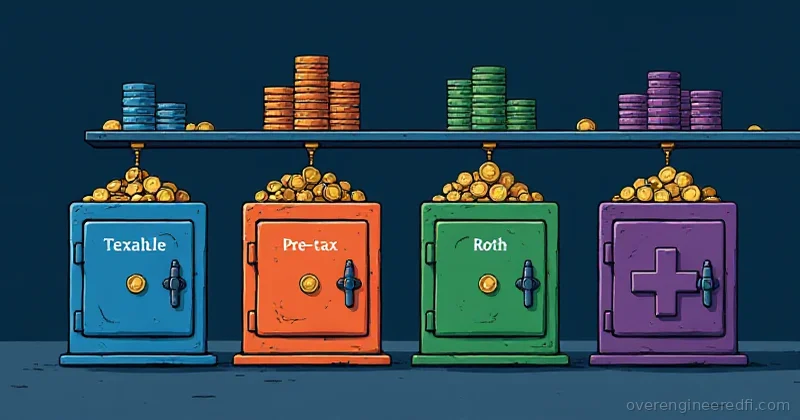
- The wrapper. One spot ETF, in the IRA if possible.
- The buys. One automatic purchase per month, capped in dollars. No extra buys on red days or green days.
- The rebalance. Twice a year, per the band, mechanical.
- The exclusions. No leverage. No yield products. No emergency fund money. No money you need within five years.
- The cooling-off rule. Any change to this page waits 30 days.
The page is dull on purpose. Its job is to lose arguments with your excited self.
What Not to Do
Leverage. A 77% drawdown on an unlevered position hurts. At 2x, a drop that size is a wipeout. Margin calls do not care about your long-term thesis.
Yield on a platform that can fail. Celsius froze withdrawals in June 2022 and filed for Chapter 11 on July 13, 2022. In January 2023 the bankruptcy court ruled that Earn deposits belonged to Celsius, which left those depositors as unsecured creditors. FTX, an exchange, filed on November 11, 2022. Neither platform’s deposits were insured like bank accounts. Yield is the premium for that risk, and the marketing page leaves the risk out.
Altcoin concentration. Splitting a 5% sleeve across eight tokens adds eight ways to lose and little diversification, since altcoins tend to fall with bitcoin. If the sleeve is small, own the biggest, most liquid asset in the cheapest wrapper and stop.
Common Questions
How much of my portfolio should be in crypto?
A crypto allocation of 1% to 5% of investable assets covers most people. Divide the dollar loss you can tolerate by 0.77, the size of bitcoin’s 2021-2022 drop. A $10,000 tolerance caps the position at about $13,000. Pick the number before buying and rebalance when it drifts.
Does the wash sale rule apply to crypto?
The wash sale rule does not apply to crypto held directly under current law, because Section 1091 covers stocks and securities. H.R. 10357, advanced by House Ways and Means in September 2026, would extend it to dispositions after the bill’s introduction if enacted. For spot crypto ETFs, treat the 31-day wait as binding.
Should I hold bitcoin ETFs in a Roth IRA?
Bitcoin ETFs fit well in a Roth IRA if you want the position long term. Gains inside the account are not taxed, and rebalancing the sleeve creates no tax bill. The tradeoff is that a loss inside the Roth gives you no deduction, and Roth space spent on a volatile sleeve is space your index funds do not get.
What is the cheapest way to own bitcoin?
A spot bitcoin ETF is the cheapest way for most people. As of November 2026, expense ratios run from 0.14% (Morgan Stanley’s MSBT) to 0.25% for the main funds, or $35 to $62.50 per year on $25,000. Grayscale’s older GBTC trust costs 1.5%, so skip it.