The Question That Doesn’t Need Three Hours of Research
You’ve been sitting on cash in a savings account while you “figure out which brokerage to use.” That has cost you real money — not hypothetically, not eventually, right now.
The longer version of this article would take 45 minutes to read and send you to a forum where someone has very strong feelings about Vanguard’s structural advantages and someone else is equally passionate about Fidelity’s ZERO funds. Both of them have been invested for 20 years and neither one is measurably better off because of their brokerage choice.
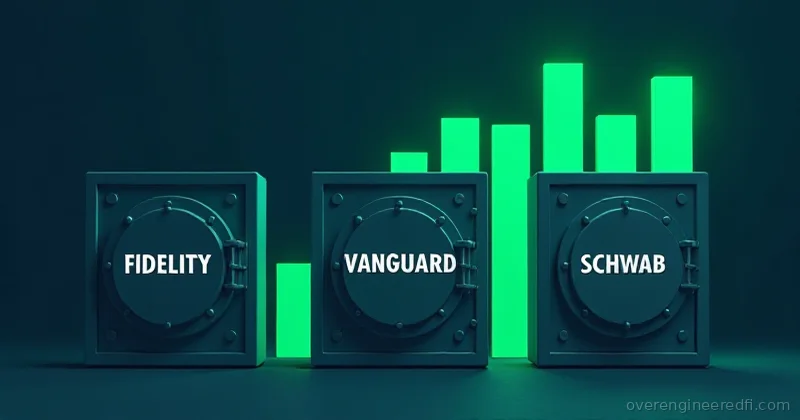
Here’s the truth: for a standard three-fund portfolio of total US market, international, and bonds, Fidelity, Vanguard, and Schwab are all excellent. The differences are real but they are not large enough to delay getting started by a single day.
That said, you asked. Here’s the actual breakdown.
Fidelity: Best Default Choice for Most People
Fidelity has quietly become the most beginner-friendly brokerage for serious long-term investors. A few things make it genuinely stand out.
ZERO Expense Ratio Funds
Fidelity offers two funds with a 0.00% expense ratio — not 0.03%, not 0.04%, literally zero:
- FZROX — Fidelity ZERO Total Market Index Fund: 0.00% expense ratio, tracks all US stocks
- FZILX — Fidelity ZERO International Index Fund: 0.00% expense ratio, tracks global ex-US stocks (developed and emerging markets)
Compare that to Vanguard’s VTI at 0.03% or Schwab’s SCHB at 0.03%. On a $1,000,000 portfolio, you’re saving about $300/year. Over 30 years with compounding on reinvested savings, that difference grows to roughly $9,000–12,000. Real money, but still not the reason to choose Fidelity.
The real reason to choose FZROX and FZILX is that zero is a psychologically clean number. You will never wonder if you’re leaving money on the table.
One catch: FZROX and FZILX are Fidelity-proprietary mutual funds. You can’t transfer them in-kind to another brokerage if you ever want to leave — you’d have to sell and rebuy, which is a taxable event in a taxable account. If you’re only using these in a 401k or Roth IRA, that doesn’t matter. In a taxable account, consider using the ETF versions (FSKAX, FZILX has no ETF equivalent — use FTIHX or VEA/VXUS instead) if you might want to leave someday.
Fractional Shares on Almost Everything
Fidelity lets you buy fractional shares of most stocks and ETFs starting at $1. This matters more than people admit. If you want to put exactly $500 into VTI and VTI is trading at $247, you can buy 2.02 shares instead of leaving $6 sitting idle. Over time, keeping every dollar invested rather than accumulating uninvested cash in the corner actually compounds.
Vanguard’s fractional share support is limited to their own ETFs in some account types. Schwab does fractional shares through their “Schwab Stock Slices” feature, but it’s limited to S&P 500 stocks.
Cash Management and the HSA Connection
Fidelity offers a cash management account that functions like a checking account with a Visa debit card — no foreign transaction fees, ATM fee reimbursements, and FDIC coverage. It’s not your primary bank, but it’s useful if you want to keep a cash buffer in the same place you invest.
Fidelity also runs the gold standard HSA — low fees, excellent investment options, good mobile app. If you’re opening an HSA through Fidelity and your brokerage is already Fidelity, that’s one less login in your life.
The App Is Actually Good
This might seem like a low bar, but brokerage apps are mostly terrible. Fidelity’s mobile app is fast, has a clean watchlist, shows your cost basis clearly, and doesn’t bury the “buy” button behind three menus. Not exciting, but functional.
Vanguard: The Right Answer If You’re Already There
Vanguard is structurally weird in a way that’s actually good for you. Most brokerages are corporations with shareholders who want profits. Vanguard is structured so that the funds own Vanguard, and you own the funds. That means you are effectively a partial owner of the company that manages your money, and their incentives are aligned with keeping your costs low rather than maximizing their fee revenue.
This isn’t just theory — it’s why Vanguard has been relentlessly driving expense ratios down for decades and why the entire industry has had to follow. VTI (Vanguard Total Stock Market ETF) charges 0.03%. VXUS (international) charges 0.07%. These are among the lowest in the industry.
If you’re already at Vanguard with a 3-fund portfolio that’s running fine, do not move. The philosophical ownership structure is a real advantage that compounds over very long time horizons.
The Interface Is a Real Problem
This is where I have to be honest: Vanguard’s website and app are noticeably behind. The UI looks like it was designed in 2014 and has been updated by committee ever since — meaning it’s gotten more complicated without getting better. The app has been improving, but it’s still noticeably behind Fidelity and Schwab.
If you’re a buy-and-hold investor who logs in four times a year to rebalance, this doesn’t matter. If you want to check your portfolio on your phone without wanting to throw the phone, it matters.
Vanguard also doesn’t have great fractional share support outside their own ETF lineup. If you want to buy individual stocks or non-Vanguard ETFs in odd dollar amounts, it’s annoying.
Best Vanguard Use Case
Vanguard is the right choice if: you’re already there, everything is working, and you’re not trying to do anything fancy. The mutual ownership structure is genuinely valuable, the expense ratios are industry-leading, and the whole point of Vanguard is to get your money in and leave it alone. It rewards people who don’t want to tinker.
Schwab: Solid. Boring. Fine.
Schwab is the brokerage equivalent of a Honda Accord. Reliable, not exciting, respectable resale value. Nothing is broken, nothing is remarkable.
Their index fund expense ratios are competitive — SCHB (US Total Market) is 0.03%, SCHF (international) is 0.06% — but slightly higher than Fidelity’s ZERO funds and roughly on par with Vanguard. That 0.03% matters about as much as choosing the slightly closer gas station.
StreetSmart Edge
Schwab’s StreetSmart Edge is a downloadable trading platform built for active traders who want advanced charting, options analytics, and order routing. If you’re reading this article, you probably aren’t that person, but it’s worth knowing it exists. If you manage a mix of long-term index investing and some active trading, Schwab lets you do both in one place without feeling like the active trading features are bolted on awkwardly.
The thinkorswim Angle
Schwab acquired TD Ameritrade in 2020 and has been migrating customers. TD Ameritrade’s thinkorswim platform was the gold standard for active traders. The migration is largely complete now — thinkorswim runs under the Schwab umbrella. So if you want serious options tools alongside your boring index portfolio, Schwab is now the only place to get that combination.
Fractional Shares and Cash Management
Schwab’s fractional share support is narrower than Fidelity’s — it works well for S&P 500 components but not everything. Their cash management features are fine but not exceptional. For most 3-fund investors, none of this moves the needle.
The Honest Comparison
| Feature | Fidelity | Vanguard | Schwab |
|---|---|---|---|
| Cheapest US index fund | FZROX 0.00% | VTI 0.03% | SCHB 0.03% |
| Cheapest intl fund | FZILX 0.00% | VXUS 0.07% | SCHF 0.06% |
| Fractional shares | Broad support | Limited | S&P 500 only |
| App quality | Good | Mediocre | Good |
| Interface | Modern | Dated | Modern |
| Mutual ownership | No | Yes | No |
| Cash management | Excellent | Basic | Good |
| Trading platform | Adequate | Basic | Excellent (thinkorswim) |
On a $200,000 portfolio split between US and international:
- Fidelity (FZROX/FZILX): $0/year
- Vanguard (VTI/VXUS at 0.03%/0.07%): ~$76/year
- Schwab (SCHB/SCHF at 0.03%/0.06%): ~$72/year
The difference between the best and worst option here is roughly the cost of two Chipotle burritos per year.
What You Should Actually Do
If you’re starting from scratch: Open a Fidelity account today. The ZERO funds are a genuine win, the app works, fractional shares are useful, and the cash management account is a nice bonus. FZROX + FZILX + FXNAX (bonds, 0.025%) is a complete three-fund portfolio at effectively zero cost.
If you’re already at Vanguard and happy: Stay. Don’t touch it. The structural ownership advantage is real, your expense ratios are industry-leading, and transaction costs from switching in a taxable account will eat any savings from moving.
If you’re already at Schwab: Also fine. Don’t move. If you’re maxing tax-advantaged accounts and buying SCHB/SCHF, you’re doing exactly the right thing at a cost that’s nearly identical to the alternatives.
If you’re at some other brokerage that charges fund commissions or has expense ratios above 0.10% on basic index funds: Now you have a reason to move. Robinhood, Acorns, and various “smart” robo-advisors with 0.25% management fees are costing you real money at scale. A 0.25% drag on $500,000 is $1,250/year compounding against you. That’s worth a brokerage transfer.
The One Thing That Actually Matters
None of this is worth spending more than one afternoon on. The brokerage you pick matters much less than:
- Whether you’re actually investing consistently
- Whether your expense ratios are under 0.10%
- Whether you’re using tax-advantaged accounts before taxable
- Whether you’re staying the course when markets drop
Fidelity, Vanguard, and Schwab have collectively kept millions of retail investors out of high-fee mutual funds and actively managed nonsense. They’ve all won. Pick the one that you’ll actually use, set up automatic contributions, and spend the time you were going to spend on brokerage research on literally anything else.
The math doesn’t care which of these three you chose. It cares whether you started.