Your Budget Works on Average, and You Live in Months
Say you net $8,000 a month and your regular spending leaves $400 free. On paper, you are fine. Then March arrives with a $1,800 car insurance renewal, and your “fine” budget is $1,400 in the hole by the end of the month. Nothing went wrong. You just built a budget out of averages, and bills do not arrive as averages.
A sinking fund fixes this. You pick each irregular expense, divide it by the months until it is due, and move that amount into a separate pot every month. When the bill shows up, the money is already there. The bill becomes a withdrawal, not an event.
This is the same idea as the “true expenses” rule in our YNAB review, and it fits on top of the pay-yourself-first setup from the budget that doesn’t feel like a budget.
Sinking Fund vs Emergency Fund
These are two different tools. An emergency fund covers things you cannot predict: a layoff, a surprise ER bill, a dead furnace in January. We sized that one in how much emergency fund you need.
A sinking fund covers things you can predict but cannot afford in one paycheck. You know the car insurance renews in March. You know Christmas is December 25. You know the domain name renews every year, because you set it to auto-renew and then forgot.
The practical difference is how you treat the balance. The emergency fund stays full and you replace anything you spend. A sinking fund fills on a schedule and gets spent on purpose. If you mix them in one account, every March looks like an emergency, and you quietly drain the cushion that was supposed to protect you from a real one.
The Math: One Division
The formula is:
monthly contribution = amount due / months until it is due
For a bill you pay once a year, and you are starting fresh right after the last one, that is annual cost divided by 12. Car insurance of $1,800 a year is $150 a month.
Here is a worked example for a tech worker household. Every number is a hypothetical example, not a national average. Swap in your own.
| Category | Annual cost | Monthly contribution |
|---|---|---|
| Car insurance | $1,800 | $150 |
| Car registration and inspection | $240 | $20 |
| Software, domains, cloud bills (AWS, annual subscriptions) | $600 | $50 |
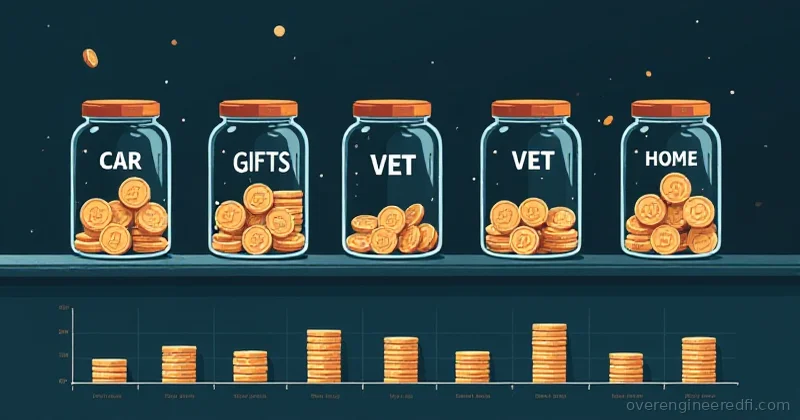
| Holiday gifts | $1,200 | $100 |
| Vet | $960 | $80 |
| Dental and medical out of pocket | $900 | $75 |
| Home maintenance | $3,600 | $300 |
| Travel | $3,000 | $250 |
| Laptop and gear ($2,400 every 4 years) | $600 | $50 |
| Car replacement | $3,000 | $250 |
| Total | $15,900 | $1,325 |
Check the sum: $15,900 divided by 12 is $1,325. That is the number to automate. It looks big because it is the sum of ten bills you were already paying, just not on a schedule you could see.
If $1,325 a month is more than you can spare, the table did its job. It showed you the real cost of your life before March did. Cut the travel line or stretch the laptop to five years. Do not skip the exercise.
Catch-Up Math When You Start Late
You do not start on the day after each bill. Say the $1,800 insurance renewal is due in 5 months and you have saved nothing. Divide by what is left, not by 12:
$1,800 / 5 = $360 a month
That is more than double the normal $150, and it only lasts until the bill is paid. After that, the fund resets and the contribution drops to $150. The first year is the painful one. Every year after is flat.
The fix for a tight first year: for the one or two nearest bills, accept the catch-up rate or cover them however you did last year. Start every other fund the day after its bill clears. A fund that starts right after its bill gets the full 12 months of runway, so it costs the normal $150 instead of $360. Starting every fund at once is faster, but the catch-up rates stack, and that first year can cost far more than the $1,325 steady state.
The Rules of Thumb for the Big Two
Two categories are too large and too fuzzy to guess. A flat dollar amount is a bad idea for either one.
Home maintenance. A commonly cited rule of thumb is to budget 1% to 4% of your home’s value per year for maintenance and repairs. The range is wide because the answer depends on age, climate, and whether you are handy with a wrench. It is a rule of thumb, not a statistic, so treat it as a starting point. In the table above, a $360,000 home at 1% is $3,600 a year, or $300 a month. An older house in a rough climate belongs near the top of the range. A newer condo with an HOA covering the roof belongs near the bottom.
Car replacement. This one is a monthly payment you make to yourself instead of to a lender. Say you expect to replace a car in 10 years and want to put $30,000 toward the next one. That is $3,000 a year, or $250 a month. Trade-in value reduces the target, and your timeline may be shorter. Unless the dealer offers 0% financing, even a partial fund beats a car loan at full price, because the loan charges interest and your fund earns it.
Where to Put the Money
You have three options. They run from easy to over-engineered, which is the natural order here.
1. Separate buckets inside one high-yield savings account. Ally says you can “create up to 30 savings buckets” in its online savings account, and it describes them as digital envelopes. As of October 23, 2026, Ally lists a rate of 3.2% APY (variable), a $0 minimum opening deposit, and no monthly maintenance fees or minimum balance requirements. SoFi lets you hold “up to 20 active Vaults at any time” inside its savings account. Capital One takes a different route: it lets you “create multiple savings accounts, each dedicated to your unique financial goals,” so each goal is a separate account rather than a bucket. Check the account page of any bank you are considering for its current limit.
2. One account plus a spreadsheet ledger. This is the over-engineered option, and it works at any bank. You keep a single savings balance and track who owns which dollars in a sheet. Each row is a category with a target, a due date, and a balance. The monthly contribution can be a formula:
=ROUNDUP((Target - Balance) / MAX(1, IFERROR(DATEDIF(TODAY(), DueDate, "m"), 0)), 2)If the target is $1,800, the balance is $450, and the due date is 5 months out, that returns ($1,800 - $450) / 5 = $270. The MAX(1, ...) stops a divide-by-zero when less than one full month is left, and the IFERROR keeps the row from showing #NUM! once the due date has passed. Roll DueDate forward a year after you pay the bill. DATEDIF counts complete months only, so it sometimes undercounts by one and asks for a little more than you need, which is the safe direction. The sheet also tells you at a glance whether the account balance matches the sum of the category balances. If they drift apart, you made a bookkeeping mistake, and you can find it.
3. YNAB-style category targets. If you already use YNAB, each sinking fund is a category with a Yearly target (with a “By” date) or a Custom target with a “Due on” date. The app runs the formula for you. The money stays in your regular accounts, so you are paying for the software, not for a better place to store cash.
One FDIC note applies to all three. Coverage is $250,000 per depositor, per insured bank, per ownership category. Buckets and sub-accounts at the same bank do not each get their own $250,000. They share the one limit. For most households holding $15,900 a year in sinking funds, this will never matter. It matters if your emergency fund and sinking funds sit at the same bank and add up to more than the limit.
What the Float Earns
Cash that sits waiting for a bill earns interest. As an estimate, a fund that fills evenly and is spent in one lump holds about half its annual total on average. For the table above, that is about $7,950 on average ($15,900 / 2). At the 3.2% rate Ally listed on October 23, 2026, that earns roughly $254 a year ($7,950 x 0.032 = $254.40).
That is a rough estimate, since the car replacement fund keeps growing instead of resetting. It is also not the reason to do this. The point is that your March bill stops being a surprise. Call the interest a small rebate for being organized. Rates move, so check yours before you plan around any figure.
When a Sinking Fund Is the Wrong Tool
Not every irregular bill needs its own fund. Skip the fund when:
- The bill is small relative to your monthly slack. If you have $400 free each month, a $60 annual domain renewal does not need a dedicated line. Just pay it.
- The bill is already monthly. (Quarterly estimated taxes are a sinking fund too, but size them from your income, not from a fixed bill.)
- You pay with a lump sum you will always have. If a December bonus reliably covers holiday gifts, the bonus is the fund.
- Keeping track costs more than it saves. Ten funds is manageable. Thirty is a hobby, and the 2 AM version of you will not enjoy maintaining it.
A good rule: if missing the bill would mean pulling from your emergency fund, give it a fund. If missing it would mean a mildly annoying week, pay it from cash flow.
Setting It Up This Weekend
- List every bill that arrives less often than monthly. Check last year’s statements, because your memory will miss at least three.
- Put an amount and a due date on each one. Use last year’s actual number, not a guess.
- Divide by the months remaining until each is due.
- Add up the monthly total and compare it to your free cash flow. Cut or stretch lines until it fits.
- Open the buckets or build the sheet.
- Automate one transfer on payday for the total. Split it across the funds in the ledger.
- When a bill lands, pay it from the fund. Do not “borrow” from another category without writing it down.
Do this once and review it once a year. When your insurance rate goes up by $200, change the target and the monthly amount. The system will tell you the new number.
Common Questions
What is a sinking fund?
A sinking fund is money you set aside in small monthly amounts for a known future expense. You divide the expected cost by the months until it is due, then save that amount every month. When the bill arrives, the sinking fund pays it without touching your regular budget.
How much should I put in a sinking fund each month?
Divide the amount due by the months remaining until the due date. A $1,800 insurance bill due in 12 months needs $150 a month. The same bill due in 5 months needs $360 a month. After the first payment, the fund resets to the standard annual rate.
Should sinking funds be in a separate account?
Sinking funds work best when you can see each balance, whether through separate buckets, a ledger, or budgeting software. A separate account is optional. One account with clear tracking is fine, as long as the sinking fund balance never gets mixed into your emergency fund.
How much should I save for home maintenance?
A commonly cited rule of thumb says to set aside 1% to 4% of your home’s value each year for maintenance. On a $360,000 home, that is $3,600 to $14,400 a year. Pick the low end for newer homes and the high end for older ones.