The Great Index Fund Debate That Isn’t Really a Debate
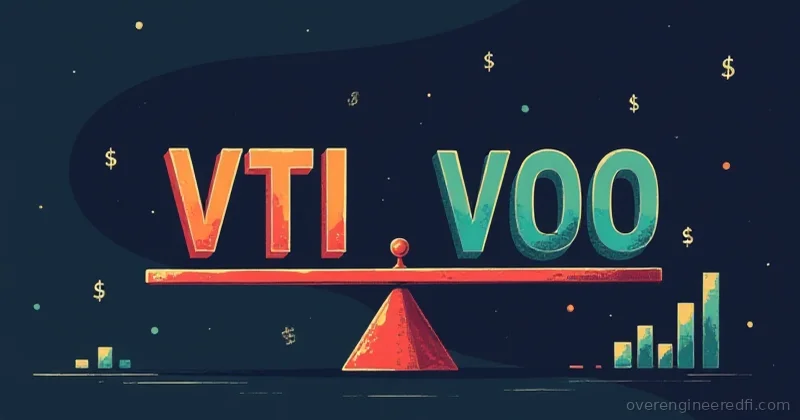
You’ve been sitting on a pile of cash in a brokerage account and now you’re staring at two nearly identical options wondering which one to pick. VTI or VOO. FSKAX or FXAIX. Total market or S&P 500. They both look almost the same. They both have insanely low expense ratios. They’re both Vanguard or Fidelity, so you know they’re legit.
And you’ve been paralyzed for three weeks.
Here’s the thing: the difference between these two funds is so small that the energy you’re spending on this decision will generate more financial harm — in opportunity cost from not investing — than any possible performance gap between the two funds. But since you’re here, let’s actually understand what you’re choosing between, because the reasons are more interesting than “just pick one.”
What You’re Actually Buying
Total market funds (VTI, FSKAX) hold every publicly traded US company — large caps, mid caps, small caps. VTI tracks the CRSP US Total Market Index, which covers roughly 3,600 stocks. FSKAX tracks the Fidelity US Total Market Index, similarly comprehensive.
S&P 500 funds (VOO, FXAIX) hold the 500 largest US companies by market capitalization, selected by a committee at S&P Dow Jones Indices that makes sure they’re profitable and meet liquidity requirements.
The punchline: approximately 84% of the total US stock market by market cap IS the S&P 500. The 500 biggest companies are so massive that they dominate the total market index. When you buy VTI, you’re basically buying VOO plus a thin slice of smaller companies on top.
That remaining ~16% is made up of mid-cap and small-cap stocks — companies valued between roughly $300 million and $10 billion. Real businesses, real revenues, but not household names.
The Numbers Side by Side
Let’s look at what you’re actually comparing:
| VTI | VOO | |
|---|---|---|
| Index tracked | CRSP US Total Market | S&P 500 |
| # of holdings | ~3,600 | ~503 |
| Expense ratio | 0.03% | 0.03% |
| Large cap weight | ~84% | ~100% |
| Small/mid weight | ~16% | 0% |
| 10-yr annualized return | ~12.5% | ~12.8% |
For the Fidelity crowd: FSKAX vs FXAIX tells essentially the same story, both at 0.015% expense ratio — so cheap that Fidelity is essentially paying you to hold them in rounding error terms.
The performance difference over the last decade? Noise. Sometimes VTI edges ahead, sometimes VOO does. The S&P 500 has actually outperformed the total market in the last 10–15 years largely because mega-cap tech (Apple, Microsoft, Nvidia, Amazon) has absolutely dominated — and those are all S&P 500 names that make up a much larger slice of VOO.
The Case for Total Market: The Fama-French Small-Cap Premium
Here’s where the academic finance people show up with their briefcases.
Eugene Fama and Kenneth French — the same people behind the efficient market hypothesis that tells you stock picking doesn’t work — identified something interesting in their 1992 research: small-cap stocks have historically outperformed large-cap stocks over long time horizons. This is the “size premium.”
The intuition makes sense: smaller companies are riskier, less liquid, less covered by analysts, and harder to research. Investors demand higher expected returns to hold them. And historically, they’ve delivered.
From 1926 to roughly 2020, US small-cap value stocks returned something like 11–13% annualized vs. 10–11% for large-cap. Not a huge difference, but compounded over decades, 1–2% per year is real money.
So what does this mean for a $100k investment over 30 years?
Let’s run the numbers with conservative assumptions:
- VOO scenario: $100,000 at 10.0% annualized = $1,744,940
- VTI scenario: $100,000 at 10.2% annualized = $1,842,671
That’s roughly $97,731 more if the small-cap premium actually materializes and you hold for 30 years. On a $100k initial investment. That’s not nothing.
But here’s the catch embedded in that analysis: the 0.2% higher return assumes the size premium persists at historical rates. That’s a big assumption — one that’s been hotly debated for the last 20 years.
The Ongoing “Does Size Premium Even Still Exist?” Debate
After Fama and French published their findings in 1992, something happened that happens every time a market anomaly gets widely documented: it started disappearing.
The argument against the size premium persisting:
- It’s been arbitraged away. Once the academic world found it, institutional money flooded into small-cap funds, bidding up valuations and compressing the return premium.
- Survivorship bias. The historical data included companies that went bankrupt or delisted. The real premium may have been smaller than the numbers suggest.
- The last 15 years. Large-cap tech has crushed everything. If you’d been tilting to small caps since 2010 for academic reasons, you left enormous returns on the table.
The argument that it probably still exists in some form:
- Structural, not behavioral. If the premium is compensation for genuine risk (illiquidity, economic sensitivity), arbitrage doesn’t fully eliminate it — you can’t arbitrage away risk.
- International evidence. The small-cap premium shows up in developed international markets too, which makes it harder to dismiss as a US data artifact.
- It shows up in factors. The factor investing literature (AQR, Dimensional) treats the size premium as real but requiring quality screens to capture cleanly.
The practical verdict on this debate for you: if you believe in factor investing and want to deliberately tilt your portfolio toward small-cap value, buy a dedicated small-cap value fund (like VBR or AVUV) on top of whatever core fund you choose. Don’t expect VTI vs. VOO to be your primary lever here — VTI’s small-cap exposure is market-cap-weighted, so it’s 84% the same thing as VOO anyway.
What About International Stocks?
Quick tangent since it comes up: neither VTI nor VOO gives you international exposure. If you want to own the actual global market, you’d pair either of them with something like VXUS (Vanguard Total International) or go with VT (Vanguard Total World), which handles the split automatically at roughly 60% US / 40% international.
That’s a separate decision from this one, but it’s a bigger lever than VTI vs. VOO if you care about true diversification.
The Tax and Logistics Angle
One place where fund choice might actually matter: your account type and platform.
- In a 401k: You don’t choose the fund family — you choose from whatever your plan offers. If your plan has FXAIX (S&P 500) but not FSKAX (total market), or vice versa, the decision is made for you. Take whatever has the lower expense ratio.
- In a taxable account: Both VTI and VOO have excellent tax efficiency as ETFs. Vanguard’s unique patent structure (which expired in 2023) historically made their mutual fund versions highly tax-efficient too, but for most people the ETF versions are fine.
- At Fidelity: FSKAX and FXAIX are both at 0.015% — effectively free. If you’re using Fidelity index mutual funds in an IRA or taxable account, FSKAX gives you the slightly broader exposure at no extra cost.
- At Vanguard: Same story. VTI and VOO are tied at 0.03%.
The fund that’s available in your plan at the lowest cost wins. Stop trying to optimize beyond that.
Making the Actual Decision
If you’re paralyzed by this choice, here’s a framework that takes about 45 seconds:
Use VOO/FXAIX if:
- Your 401k only offers an S&P 500 option
- You prefer the simplicity of “own the 500 biggest US companies”
- You want to track something your coworkers will recognize when the market’s up (“hey, S&P hit a new high”)
Use VTI/FSKAX if:
- You believe in capturing the full US market in one fund
- You want the marginal small/mid-cap exposure without tilting hard
- You’re at Fidelity and FSKAX is slightly cheaper (it is, by 0.015%)
Either one is correct. The difference in expected outcomes over 30 years at realistic return assumptions is smaller than the variance you’ll experience from a single bad year in the market. We’re talking about a rounding error on a rounding error.
The catastrophically wrong answer is to keep reading Reddit threads about this instead of investing the money. Every month you spend “deciding” is a month of compound growth you’re not getting.
The Bottom Line
VTI owns the whole US market. VOO owns the 500 largest US companies. Those two groups overlap at ~84% by market cap. The small-cap exposure in VTI gives you theoretical access to the size premium, which has historically been real but has underperformed for the last decade and a half.
On a $100k portfolio over 30 years, you’re looking at a potential difference of roughly $100k — if everything goes the academic finance way. That matters! But it’s also a wildly uncertain number that depends on return differentials maintaining over a full generation.
Pick the one your platform offers at the lowest cost. Pick the one you’ll actually hold during a 40% drawdown without second-guessing. Then automate contributions and redirect your optimization energy toward your savings rate — a 1% increase in what you save will have 10x the impact of this fund choice.
Your 2 AM self — the one doing FIRE calculations on a Tuesday — does not care whether you picked VTI or VOO. They care that you actually invested.