
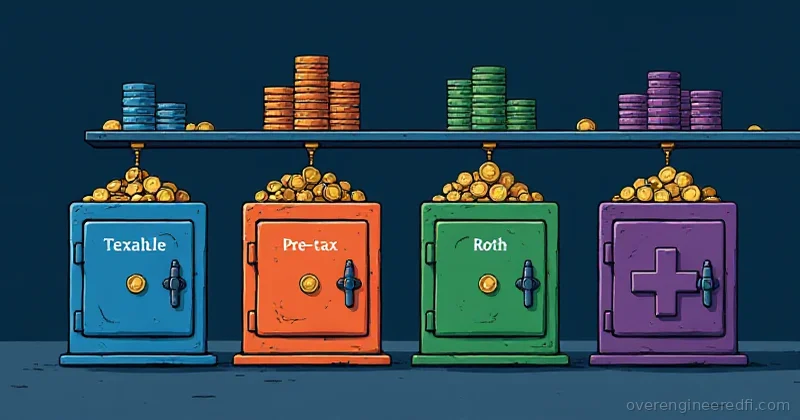
You Already Picked Your Funds. Now Pick Their Addresses.
You have a 70/30 stock/bond split, three account types, and no plan for which fund lives where. So you spread a little of everything across every account, because that feels tidy. It is also leaving money on the table.
Asset location means holding each fund in the account where its tax bill is smallest. On the $300,000 portfolio we build below, it saves about $543 a year in tax versus a 70/30 split inside every account, and about $1,086 versus the worst layout (all bonds in taxable), with the same funds and the same allocation. It ranks behind your savings rate and your stock/bond split, so do those first. After that, the rules are short: tax-inefficient funds (bonds, REITs) go in pre-tax accounts, the highest-growth funds go in Roth and HSA, and broad stock index funds fill the taxable account.
Where the Tax Drag Comes From
Every dollar a fund throws off gets taxed in a different way, depending on what kind of dollar it is. As of October 2026, here is the ranking from worst to best for a taxable account:
- Interest from bond funds is taxed as ordinary income every year, at your full marginal rate.
- Nonqualified dividends (REITs, some high-yield funds) are also taxed as ordinary income.
- Qualified dividends from stock funds are taxed at 0%, 15%, or 20%.
- Unrealized gains are not taxed at all until you sell. Then they are taxed at those same long-term rates.
The 2026 rate thresholds come from IRS Rev. Proc. 2025-32. Qualified dividends and long-term gains are taxed at 0% up to $49,450 of taxable income (single) or $98,900 (married filing jointly). They are taxed at 15% up to $545,500 (single) or $613,700 (joint), and 20% above that. Ordinary income hits 32% starting at $201,775 of taxable income for a single filer.
Now add the 3.8% NIIT. It applies to interest and dividends once your MAGI crosses $200,000 (single) or $250,000 (joint). Those thresholds are not indexed for inflation. For a tech worker with RSU income, you are probably over the line.
So a high earner pays about 35.8% on bond interest (32% plus 3.8%) and 18.8% on qualified dividends (15% plus 3.8%). Same dollar of income, almost double the tax. That gap is the opportunity.
The Worked Example: $300k, Two Layouts
Here is the portfolio. You are a single filer in the 32% bracket with MAGI over $200,000. You hold:
- $150,000 in a taxable brokerage account
- $100,000 in a traditional 401(k)
- $50,000 in a Roth IRA
- A 70/30 target: $210,000 in stock funds, $90,000 in bond funds
These yields are assumptions, not quotes. Assume the bond fund yields 4.0% and the stock fund pays a 1.2% qualified dividend. Assume the stock price growth is unrealized, so it is untaxed this year. State tax is ignored for now.
Layout A (the “bonds wherever there was room” layout):
- Taxable: $90,000 bonds plus $60,000 stocks
- 401(k): $100,000 stocks
- Roth: $50,000 stocks
Annual tax in the taxable account:
- Bond interest: $90,000 x 4.0% = $3,600, taxed at 35.8% = $1,288.80
- Stock dividends: $60,000 x 1.2% = $720, taxed at 18.8% = $135.36
- Total: $1,424.16
Layout B (location-optimized):
- Taxable: $150,000 stocks
- 401(k): $90,000 bonds plus $10,000 stocks
- Roth: $50,000 stocks
Annual tax in the taxable account:
- Stock dividends: $150,000 x 1.2% = $1,800, taxed at 18.8% = $338.40
- Bond interest inside the 401(k): $0 this year
Layout B saves $1,424.16 minus $338.40, or $1,085.76 per year. Both layouts hold exactly $210,000 of stock and $90,000 of bonds on screen. (The after-tax view in the Roth section shifts that a little.)
If you split 70/30 inside every account instead, taxable holds $45,000 of bonds and $105,000 of stock, and the tax is $881.28. Layout B still beats that by $542.88 a year.
That is 0.36% of the portfolio per year. Save that $1,086 every year and invest it at an assumed 6%, and after 20 years you have roughly $40,000 more. This is a simplified static estimate (balances grow, so the real gap would be larger, and yields change). It is also a free return boost. You pay no fee, and the only catch is the after-tax allocation shift covered below.
It is still small next to the big levers. A 5% change in your savings rate on a $200,000 salary is $10,000 a year. Do not spend a weekend on asset location while your 401(k) match sits unclaimed.
The Roth Rule: Put the Highest Growth Where It Never Gets Taxed
Roth money is never taxed again, so it should hold whatever you expect to grow the most. That is usually stocks. The math on the $50,000 Roth, over 20 years:
- At an assumed 7% stock return: $50,000 grows to about $193,484
- At an assumed 4% bond return: $50,000 grows to about $109,556
That $83,928 gap is mostly the stock/bond return difference, not the Roth itself. The bonds still have to sit somewhere, and your total allocation stays the same. The location win is smaller but real: stock growth in the Roth is never taxed, while the same growth in the 401(k) gets taxed on the way out. Put bonds in the Roth and you spend your best shelter on your slowest asset.
There is one catch. A pre-tax dollar is not a Roth dollar. Your $100,000 traditional 401(k) carries a hidden tax bill. If you withdraw it at a 24% rate in retirement, it is worth about $76,000 after tax. Your $50,000 Roth is worth $50,000 in full. So the simple rule “highest return goes in the account that is least taxed later” needs one adjustment: compare accounts by after-tax value, not by the balance you see on screen.
In practice, Layout B still wins for most people: bonds in the traditional account, stocks in the Roth. The after-tax view matters when you count your allocation. That $100,000 401(k) is closer to $76,000 of your money, so the bonds parked there are a smaller share of your real portfolio than the screen suggests. If you want to be precise, size your bond target off after-tax balances. See Roth vs Traditional for the contribution side of this.
Bonds in the traditional account also keep that balance smaller later. Take $100,000 in a 401(k) for 25 years. At an assumed 4% it grows to about $266,584. At an assumed 7% it grows to about $542,743. A bigger traditional balance means bigger required minimum distributions (RMDs) and a bigger taxable bill in retirement. That is a trade-off, not a free win, but it is a reason not to feel bad about bonds there.
HSA: The Best Account You Probably Underuse
An HSA has a triple tax advantage: deductible contributions, tax-free growth, and tax-free withdrawals for medical expenses. If you can pay current medical costs out of pocket and invest the HSA, treat it like a Roth with a better deal. Put your highest-growth fund in it, usually your stock index fund. Check that your HSA provider offers real index funds, not just a cash sweep. For the full mechanics, read HSA triple tax advantage.
If you spend the HSA on medical bills each year, it behaves like a checking account. Keep it in cash.
The Ranked Table: Least Tax-Efficient to Most
Use this as a cheat sheet. As of October 2026, the tax treatment below reflects current federal law.
| Rank | Asset | Why it is taxed badly (or well) | Best home |
|---|---|---|---|
| 1 | Taxable bond funds, high-yield bonds | Interest taxed as ordinary income each year | Traditional 401(k) / IRA |
| 2 | TIPS, TIPS funds | Inflation adjustments taxed as ordinary income each year (phantom income for individual TIPS) | Traditional or Roth |
| 3 | REITs | Mostly nonqualified dividends (199A trims the rate, NIIT still applies) | Traditional or Roth |
| 4 | Actively traded funds with capital gain distributions | Short-term gains taxed as ordinary income | Any tax-advantaged account |
| 5 | Your highest expected growth stock fund (small-cap value, for example) | Taxed fine in taxable, but tax-free growth is worth most here | Roth, HSA |
| 6 | International stock funds | Foreign tax credit works only in taxable | Taxable |
| 7 | Broad US stock index funds | Qualified dividends, deferred gains | Taxable |
| 8 | Municipal bonds | Federally tax-exempt interest | Taxable (high brackets only) |
Fill the shelter space from the top of this list down, but skip international funds, since they lose the foreign tax credit inside a shelter. Whatever is left over goes in taxable.
The Special Cases
REITs: Ordinary Dividends With a Discount
REIT dividends are mostly nonqualified, so they are taxed as ordinary income. There is one break. Section 199A lets you deduct 20% of qualified REIT dividends (held more than 45 days), and the One Big Beautiful Bill Act of 2025 made the deduction permanent. The IRS instructions for Form 8995 describe the 20% REIT deduction.
Take $20,000 in a REIT fund that yields an assumed 4%. That is $800 of dividends. At 32%, the 199A deduction cuts the federal rate to 25.6%. The 3.8% NIIT does not get that discount. So the effective rate is about 29.4%, and the tax is about $235. Without the deduction it would be $286. Inside an IRA it would be $0. The 199A break helps, but it does not beat a shelter.
International Funds: Taxable Is the Exception
International funds hold foreign stocks, and foreign countries withhold tax on dividends. In a taxable account you can claim the foreign tax credit (IRS Topic 856). In a 401(k), traditional IRA, or Roth IRA, you cannot. The tax is just lost.
The VXUS post on this site puts the drag at roughly 0.1% to 0.3% a year, depending on country mix. That is approximate and changes every year. On $30,000 of VXUS at 0.2%, the lost credit is about $60 a year. Small, but free to avoid. Note that you must hold the stock for at least 16 days around the ex-dividend date to qualify. A plain buy-and-hold index fund meets that easily.
If taxable space is limited, international funds get first claim on it, ahead of US stock funds.
Treasuries, Munis, and the State Tax Angle
Interest on US Treasury securities is exempt from state income tax (31 U.S.C. 3124). If you live in a high-tax state, Treasury funds in taxable beat the same interest in a corporate bond fund. Assume a 9% state rate. On $3,600 of interest, the state would take $324. Treasury interest avoids that. This applies to direct Treasury interest. Funds pass it through as a state-exempt percentage on their year-end tax documents, and California, Connecticut, and New York allow it only if the fund holds at least 50% in US government obligations. Check yours.
Municipal bonds are the exception when your pre-tax space is full and some bonds have to sit in taxable. At a 35.8% combined rate (muni interest also skips the NIIT), a 3.0% muni yield equals a taxable yield of 3.0% / (1 - 0.358) = 4.67%. A 4.0% taxable bond in that same taxable account leaves you 2.57% after tax. So the muni wins by 0.43 points. Do not put munis in an IRA, though, because the tax exemption would be wasted. This works only in high brackets.
TIPS and I Bonds
TIPS inflation adjustments are taxed as ordinary income each year, even though you do not receive the money until maturity. On $10,000 of TIPS with a 3% adjustment, that is $300 of phantom income, or $96 of tax at 32%. This matches the example in I Bonds and TIPS. Hold TIPS in a traditional or Roth account. I Bonds are a different case. They defer federal tax until redemption, and they live in TreasuryDirect, so location does not apply.
When Location Does Not Matter (Or Backfires)
Asset location is a small optimization, and several things can make it worse. Check these before you rearrange anything.
- You only have one account type. If everything sits in a 401(k), there is nothing to locate. Skip this post and go invest.
- Don’t break your allocation to chase location. Your 70/30 plan comes first. Location decides where each fund sits, not how much of it you own. If shuffling funds between accounts leaves you at 60/40 instead of 70/30, you broke the plan. Count every account together, as in rebalancing.
- Wash sales cross accounts. If you harvest a loss in your taxable VTI and your IRA buys VTI within 30 days, the loss is disallowed (Rev. Rul. 2008-5). Worse, the disallowed loss does not get added to the IRA’s basis, so it is gone for good. That makes tax-loss harvesting trickier when you reinvest dividends in a retirement account. Turn off dividend reinvestment in the IRA during the window.
- Target-date funds break location. A 2055 fund holds a mix of stocks and bonds in every account, so you cannot put bonds in the 401(k) alone. If your 401(k) is all target-date, either accept it or use the fund for the whole portfolio.
- Liquidity beats location. An emergency fund or a house down payment belongs in cash or short bonds in a taxable account. Tax efficiency does not matter if you cannot reach the money without a penalty.
- You are in the 12% bracket or the 0% dividend zone. Under $49,450 of taxable income (single, 2026), your qualified dividends are taxed at 0% and bond interest at 10% or 12%. On the example portfolio, the yearly saving drops from $1,086 to about $432, so location is worth less, but not zero.
The Order of Operations
Do these in order, and stop when the next step is not worth your time.
- Set your allocation (70/30, 80/20, whatever you chose).
- Max the match and your savings rate.
- Put bonds, TIPS, and REITs in the traditional account until you run out of room.
- Put your highest-growth stock fund in the Roth and HSA.
- Put international and broad US stock funds in taxable.
- Check the total against your target once a year.
Do this once. Revisit it when your account sizes change a lot, like after an RSU vest or a rollover. The math on a $300,000 portfolio is $543 to $1,086 a year. On a $1,000,000 portfolio with the same mix, it is roughly $1,800 to $3,600. The time cost is one afternoon.
Common Questions
Should bonds go in a Roth IRA or a traditional IRA?
Bonds belong in the traditional IRA first. Bond interest is taxed as ordinary income, so tax deferral helps it most, and Roth space is better spent on stocks, which have the higher expected growth. Use the Roth for bonds only after your traditional and 401(k) space is full.
Is asset location worth it for a small portfolio?
Asset location pays little on a small portfolio. At $30,000 spread across accounts, the tax saving is roughly $50 to $100 a year at the rates used here. Focus on your savings rate and your allocation first. Revisit asset location once your taxable account holds bonds worth more than a few thousand dollars.
Do I put REITs in a 401(k) or a taxable account?
Put REITs in a traditional 401(k) or an IRA when you can. REIT dividends are mostly nonqualified and taxed as ordinary income. The Section 199A deduction of 20% on qualified REIT dividends helps in taxable accounts, but a retirement account defers the tax entirely.
Do I lose the foreign tax credit if I hold VXUS in an IRA?
Yes. A retirement account cannot claim the foreign tax credit, so the tax withheld by foreign countries on VXUS dividends is lost. Holding international funds in a taxable account lets you claim the credit on your return. The amount is small, roughly 0.1% to 0.3% of the balance a year.
Does asset location matter if I use a target-date fund?
Asset location does not apply to a target-date fund because the fund holds stocks and bonds together in every account. You cannot split its holdings between accounts. If your 401(k) offers only target-date funds, use it as your core holding and place other funds in your IRA or taxable account around it.