
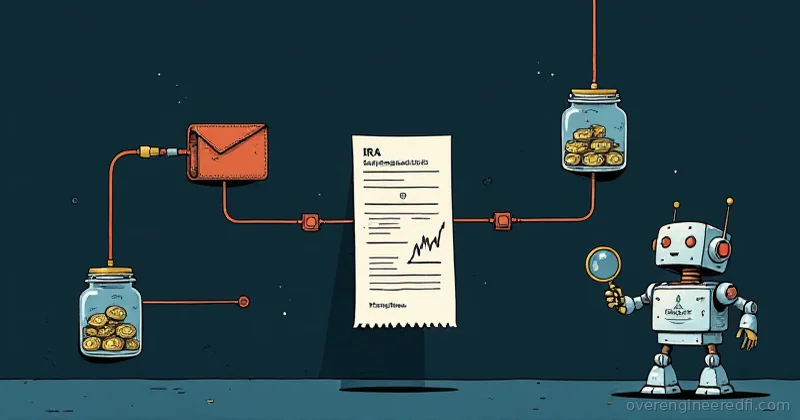
Your Broker Checks One Account. The IRS Checks Everything You Control.
You harvested a loss in November, felt smart, and bought the same fund in your Roth IRA a week later because it was “retirement money, totally separate.” That loss is gone. Not deferred. Gone. Your broker never warned you, because your broker never saw it.
Wash sale enforcement has a blind spot the size of your entire financial life. Brokers only have to report wash sales inside one account. The IRS rule covers your IRA, your spouse, your ESPP, your RSU vests, and your dividend reinvestment. Each of those can shrink or defer a harvested loss, and the IRA version deletes it.
If you need the basics (the 61-day window, fund swap pairs like VTI to ITOT), read the tax-loss harvesting guide first. The one-paragraph version: sell at a loss, buy a substantially identical security within 30 days before or after, and the loss is disallowed for that year. Pub. 550 lists what counts as a purchase: buying the stock, acquiring it in a fully taxable trade, acquiring a contract or option to buy it, or acquiring it for your IRA or Roth IRA. The rest of this post is the fine print on those rules.
Why Your 1099-B Lies by Omission
Treasury Regulation 1.6045-1(d)(6)(iii) tells brokers when they must apply the wash sale rules. The short version: both the sale and the purchase must be covered securities with the same CUSIP number in the same account. The regulation says a broker is not required to apply the rule when the purchase and sale happen in different accounts.
So your 1099-B box 1g (wash sale loss disallowed) can show only a slice of the real picture. It can miss:
- A purchase in a different account at the same broker.
- A purchase at a different broker.
- A purchase in an IRA, even one at the same firm.
- A purchase by your spouse.
- Company stock you acquired through RSU vests or an ESPP, if the broker holding your sale never saw the acquisition.
None of this changes your obligation. The statute (IRC 1091) applies to you, not to your broker’s software. If a wash sale happened and the 1099-B did not show it, you fix it on Form 8949. Enter code W in column (f) and the disallowed loss as a positive number in column (g). The Form 8949 instructions say that if the amount on the 1099-B is wrong, you enter the correct figure, and if you enter less than the 1099-B shows you attach a statement explaining the difference.
Missing a wash sale means you claimed a deduction you were not allowed. That is an underpayment, with interest, on a loss you could have just deferred.
Trap 1: The IRA Purchase That Deletes Your Loss
This is the expensive one. In Rev. Rul. 2008-5, the IRS looked at a person who sold 100 shares of stock at a loss on December 20 and had their IRA or Roth IRA buy 100 shares of the same stock on December 21. The holding: the loss on the sale is disallowed under section 1091, and the taxpayer’s basis in the IRA is not increased by the disallowed loss.
In a taxable account, a disallowed loss gets added to the basis of the replacement shares, so you get it back later. An IRA has no basis adjustment to receive it. The loss disappears.
Worked example. You bought 100 shares of a fund at $100 ($10,000 basis) more than a year ago. In November the fund drops. You sell all 100 shares at $60 and collect $6,000. Your loss is $10,000 minus $6,000, which is $4,000.
Three days later, your IRA’s auto-invest buys 100 shares of the same fund at $60 for $6,000.
- Taxable loss allowed: $0.
- Basis added to the IRA shares: $0.
- Permanent loss of deduction: $4,000.
What does that cost? The tax the loss would have saved:
- Against long-term gains taxed at 15% (a single filer in 2026 pays 15% on long-term gains from taxable income above $49,450 up to $545,500): $4,000 x 15% = $600.
- Against short-term gains in the 32% bracket (single filers pay 32% on taxable income from $201,775 to $256,225 in 2026): $4,000 x 32% = $1,280.
The IRA shares will carry whatever tax treatment the IRA has. The $4,000 loss never shows up anywhere. A fund swap into a different index would have cost you nothing here.
The Roth IRA version is just as bad. Roth shares grow tax-free, but the loss you gave up does not come back through a tax-free door. It is simply gone.
The ruling covers an IRA or Roth IRA you establish for yourself. It does not address anything beyond that, and it expressly leaves section 4975 (prohibited transactions) alone.
Trap 2: Your Spouse’s Account
Pub. 550 says it in one plain sentence: “If you sell stock and your spouse or a corporation you control buys substantially identical stock, you also have a wash sale.”
The sentence does not mention filing status. It says spouse. I found nothing in Pub. 550 that carves out married filing separately, so do not plan around filing separately as protection.
The practical version: you harvest VTI losses in your account, and your spouse’s brokerage account buys VTI inside the same 61-day window. That is a wash sale. A spouse’s IRA purchase is a closer call, because Rev. Rul. 2008-5 addresses only your own IRA. Avoid it rather than test it.
Fix: one person owns the harvest calendar. Tell your spouse the exact funds you sold and the dates.
Trap 3: RSU Vests Are Purchases
Your RSUs vest and shares land in your account. The IRS has not issued guidance that names RSUs, but the closest example points one way. Pub. 550 has an example about an employee who gets 10 shares of corporate stock as a bonus, includes the value in income, and sells them at a loss. If another bonus award of substantially identical stock arrives within 30 days of the sale, the loss on the sale cannot be deducted.
An RSU vest is not literally a bonus award, but the logic transfers and I would not bet your return on a distinction. Treat every vest as a purchase.
This hits tech workers the hardest. You hold old lots of your employer’s stock, the price is down, and you sell to harvest the loss. Then your quarterly vest lands two weeks later.
Worked example. You hold 200 shares of ACME with a basis of $60 per share ($12,000). ACME trades at $45. On March 3 you sell all 200 shares for $9,000. Loss: $12,000 minus $9,000 = $3,000, or $15 per share.
On March 15, 50 RSU shares vest at a market price of $46. Their value is $2,300 (50 x $46), and that amount already hit your paycheck as wages.
Only 50 replacement shares came in, so only 50 of the 200 sold shares are matched.
- Disallowed loss: 50 shares x $15 = $750.
- Allowed loss: 150 shares x $15 = $2,250.
- Check: $750 + $2,250 = $3,000.
- New basis of the 50 vested shares: $2,300 + $750 = $3,050, or $61 per share.
The $750 is deferred, not lost. When you eventually sell those 50 shares, the higher basis ($3,050 instead of $2,300) absorbs it. Your holding period for the new shares includes the holding period of the shares you sold, per Pub. 550.
The window runs both directions. A vest 20 days before your sale counts the same as a vest 20 days after.
Your broker may not know. Many equity plan administrators and brokerages are separate systems. If the vest happened in one place and the sale in another, no 1099-B box 1g will save you, and that makes it your job to fix on Form 8949.
Trap 4: ESPP Purchases
An ESPP buys shares for you on a schedule. An ESPP purchase is an acquisition of stock, and Pub. 550 lists acquiring substantially identical stock as a wash sale trigger. The purchase date is the clear trigger. The start of an offering period also grants you an option to buy, and IRC 1091 covers options, so keep loss sales away from both dates.
Worked example. You sell 100 shares of company stock at a $2,000 loss on June 20. Your ESPP purchase period ends June 30 and buys 40 shares. That purchase is inside the window. Forty of the 100 shares sold are matched: $2,000 x 40/100 = $800 disallowed, $1,200 allowed. The $800 gets added to the basis of the 40 ESPP shares, the same way it did for the RSU shares.
The fix is boring. Look up your purchase dates once per year and put them on a calendar. Do not harvest company stock within 30 days of one.
Trap 5: DRIP and Auto-Invest
A dividend reinvestment plan is a purchase. A $40 dividend that reinvests into 0.4 shares of the fund you just sold is a replacement purchase, and it can wash 0.4 shares’ worth of your loss. Small dollars, but it shows up as extra 8949 lines and will not be on a statement you can trust if the reinvestment is in a different account.
Auto-invest in a taxable account is the bigger one. A $500 monthly auto-buy of the fund you sold keeps buying through the window. Match by share count: sell 100 shares at a $1,000 loss, and each $500 auto-buy at $50 per share adds 10 shares. A 61-day window always catches at least two monthly buys, so 20 shares are matched. That disallows $1,000 x 20/100 = $200.
What About Your 401k?
This is unsettled. Rev. Rul. 2008-5 covers IRAs and Roth IRAs. The IRS has not issued a comparable ruling on 401k purchases, as far as I could find. The reasoning in the ruling (you directed the purchase and have command over the account) could extend to a 401k where you pick the funds, but nobody can point you to a ruling that says it does or does not.
You have a choice between certainty and a guess. The conservative approach: if you harvest a fund in a taxable account, treat your 401k’s payroll contributions to the same fund as a purchase, or switch the 401k contribution to a different fund for the 61-day window. Giving up a month of a 401k allocation costs you nothing. Guessing wrong costs you the loss.
Partial Wash Sales: Count the Shares
You do not lose the entire loss because of a small replacement purchase. Pub. 550 says that if the number of replacement shares is more or less than the number sold, you match the replacement shares to an equal number of the sold shares, in the order bought, starting with the first shares bought.
Pub. 550 gives this one. You bought 100 shares of M stock for $5,000. In the window, you bought 50 shares for $2,750 and 25 more for $1,125. You sold the 100 original shares for $4,000, a $1,000 loss. Seventy-five shares are matched:
- Disallowed: $1,000 x 75/100 = $750.
- Allowed: $250.
- The 50-share lot’s basis goes up by two-thirds of $750 ($500): $2,750 + $500 = $3,250.
- The 25-share lot’s basis goes up by the remaining $250: $1,125 + $250 = $1,375.
This is why a $20 DRIP purchase is not worth panicking about, and why a $2,000 auto-buy is.
What Happens in a Taxable Account
When the replacement shares sit in a taxable account you own, nothing is lost. A spouse’s purchase likely works the same way, but neither Pub. 550 nor the statute says so in writing. Per Pub. 550, IRC 1091(d), and IRC 1223(3):
- The disallowed loss is added to the basis of the new shares.
- The holding period of the new shares includes the holding period of the shares sold.
- When you sell the new shares and the sale is not itself inside another wash sale window, the deferred loss comes back through the higher basis.
The deferral can still sting. If you needed the loss this year to offset a gain, the deduction moves to a later year, and a lot can change between now and then.
The Playbook
Use this before you click “sell” on a loser.
- Turn off DRIP on the fund you plan to sell. Do it at least 31 days before the sale if you can, and leave it off for 30 days after.
- Pause auto-invest in taxable accounts, IRAs, and (to be conservative) your 401k, for any fund that matches the one you are harvesting.
- Check your calendar for vests and ESPP purchases before harvesting company stock. If a vest lands within 30 days either side, either wait or accept a partial wash sale and run the share-count math.
- Tell your spouse which fund you sold and the date range. Ask them to skip it in every account they control.
- Swap into something not substantially identical. A different index from a different provider is the usual route. The standard is facts and circumstances, per Pub. 550, so do not assume two funds that track the same index are different.
- At filing time, scan your accounts for purchases in the window and fix your 8949 with code W and a column (g) adjustment, even if the 1099-B said nothing.
Your 2 AM self will thank you for the calendar reminder.
Common Questions
Does buying in my Roth IRA trigger a wash sale?
Yes. Rev. Rul. 2008-5 holds that a loss sale is disallowed when your IRA or Roth IRA buys substantially identical securities within 30 days before or after the sale. Your Roth IRA’s basis is not increased, so the loss is permanently lost rather than deferred.
Does the wash sale rule apply to gains?
No. The wash sale rule applies only to losses. If you sell a stock at a gain and buy the same stock back the next day, you owe tax on that gain as normal. The wash sale rule limits the deduction side only.
Is the 30-day wash sale window calendar days or trading days?
Calendar days. IRC 1091 covers a period beginning 30 days before the sale date and ending 30 days after it, which is 61 days including the sale date. Weekends and market holidays count. Mark the last day on a calendar, not by counting trading sessions.
What happens if I sell the replacement shares in a wash sale?
The deferred loss is recognized then. Your replacement shares carry a higher basis equal to their cost plus the disallowed loss, so selling them at a lower price produces a larger loss. If you buy more substantially identical shares within 30 days of that sale, the cycle can repeat.
Do wash sale rules apply to crypto?
No, not for crypto you hold directly, under current law. IRC 1091 covers stock or securities, and directly held crypto is property. H.R. 10357, advanced by House Ways and Means in September 2026, would extend the wash sale rule to digital assets if enacted. Spot crypto ETFs are different: treat them like stock funds and wait 31 days.