
You Got Laid Off at 56 and Your 401k Is Locked Until 59.5. Or Is It?
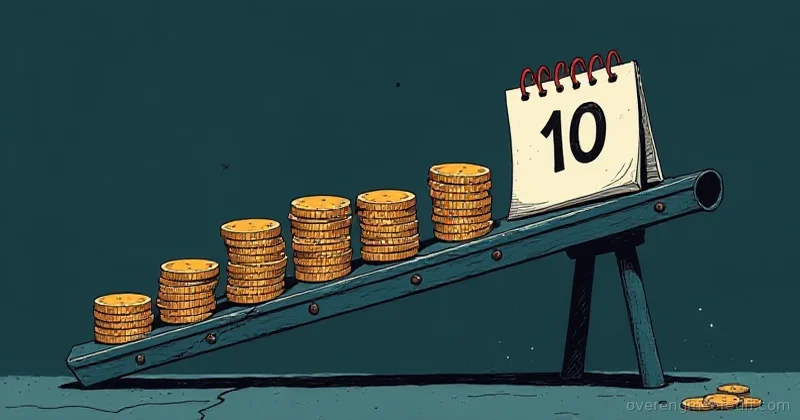
The Rule of 55 lets you take penalty-free withdrawals from your 401k or 403b if you leave that employer in or after the calendar year you turn 55. No 10% penalty, no 72(t) paperwork, no five-year ladder. For a 401k or 403b, it is the simplest early-access route, and the most common way people lose it is by being helpful: rolling the 401k into an IRA on the way out the door.
So the thesis is short. If you are 54 or 55 and might leave your job, keep the money in the plan until you have decided how you want to bridge to 59.5. Rolling over is a one-way door. Staying put is free.
The Rule, Stated Plainly
The IRS adds a 10% tax on distributions before age 59.5. One listed exception covers distributions you take after you separate from service with the employer sponsoring the plan, if the separation happens during or after the year you reach 55. The IRS states it in its early distributions table as separating “during or after the year the employee reaches age 55.” The statutory home is IRC 72(t)(2)(A)(v).
Three words in that sentence do all the work: separate, from, service. Quit, get laid off, get fired, take a buyout. All count. Staying employed and taking an in-service withdrawal does not.
The “Year You Turn 55” Detail Is Generous
The test is the calendar year, not your birthday. Say you turn 55 on December 20, 2027. If you leave in January 2027, you were 54 when you left, but you separated during the year you turn 55. You qualify.
Now flip it. You leave at 53 in 2025, wait two years, and turn 55 in 2027. You do not qualify. The separation happened before the year you reach 55, and sitting around until you are older does not fix it.
If you are 54 and thinking about quitting, December 31 versus January 2 can be the difference between qualifying and not. Check your own birth year against your last day before you sign anything.
Only the Plan You Just Left Counts
The exception applies to the plan of the employer you separated from. Not your old employer’s plan from 2016. Not an IRA. Not the 401k at the job you left at 48.
Here is the legitimate fix. If your old 401k from a previous employer can be rolled into your current employer’s plan, and your current plan accepts incoming rollovers, do it before you separate. Once that money sits inside the current plan, it is part of the plan you leave and rides along under the Rule of 55. This is the one rollover worth considering before a layoff. Not every plan accepts rollovers in, so call the plan administrator while you still have a badge.
IRAs are excluded entirely. The IRS table marks the separation exception “no” for IRAs, including SEP and SIMPLE IRAs. A rollover IRA withdrawal at 56 gets the 10% penalty unless some other exception applies.
Why You Must Not Roll It Into an IRA First
This is the trap. You get laid off. HR hands you a packet. A friendly brokerage rep calls and offers to “consolidate” your 401k into a rollover IRA with better fund choices. It sounds responsible. It also converts penalty-free money into penalty-bearing money.
Run the numbers. Roll $900,000 to an IRA, then withdraw $70,000 at 56. The penalty is $7,000. Over a 3.5-year bridge to 59.5 at $70,000 a year, that is $24,500 in penalties you could have avoided by leaving the money where it was.
You can still roll over later, after you no longer need the access. Many people keep the 401k in place for years, since some big-employer plans have institutional-class index funds as cheap as the best retail IRA options (0.02% to 0.05%), so leaving the money there costs nothing extra. Check the fund lineup before you assume the IRA is better.
Age 50 for Public Safety Workers
For qualified public safety employees, the threshold drops to separation in or after the year you turn 50. The IRS page covers public safety employees of state and local governments in a governmental defined benefit or defined contribution plan, plus specified federal law enforcement officers, customs and border protection officers, federal firefighters, and air traffic controllers (added in 2015), and corrections officers and private-sector firefighters (added by SECURE 2.0). SECURE 2.0 also lets qualifying public safety workers use 25 years of service under the plan instead of age 50, whichever comes first. If you are one of them, the same mechanics apply with a lower age. Most tech workers are not, so the rest of this post assumes 55.
The Worked Example: 56, Laid Off, $900,000
Meet Dana. She is 56, laid off in 2026, and has $900,000 in the traditional 401k of the employer she just left. She wants $70,000 a year to cover living costs until 59.5, which is 3.5 years away. Total needed: $245,000. Her taxable brokerage account is thin, so the 401k is the bridge.
Penalty avoided. The 10% penalty on $70,000 is $7,000 per year. Across 3.5 years, that is $24,500 she keeps.
Income tax still applies. The Rule of 55 removes the penalty only. Every dollar from a traditional 401k is ordinary income. Using the 2026 single standard deduction of $16,100 and 2026 brackets (10% to $12,400, 12% to $50,400, 22% to $105,700, from the IRS inflation release), assume no other income:
- Taxable income: $70,000 minus $16,100 = $53,900.
- 10% on the first $12,400: $1,240.
- 12% on the next $38,000: $4,560.
- 22% on the last $3,500: $770.
- Total federal tax: $6,570, an effective rate of about 9.4% on the $70,000.
Withholding is not the bill. Here is a fun quirk. If the plan pays you directly, federal law requires 20% mandatory withholding on eligible rollover distributions (IRC 3405(c)). The IRS says this applies “even if you intend to roll it over later.” On $70,000 that is $14,000 withheld, against a real bill of $6,570. She gets about $7,430 back at filing. That is a free loan to the IRS, and the refund is a year late.
Dana cannot elect less than 20%. The withholding is mandatory on any eligible rollover distribution paid to her, and only a direct rollover avoids it. She can raise it, never lower it. Her real lever is to treat the over-withholding as prepaid tax: skip estimated payments she would otherwise owe on other income, or draw slightly larger amounts so the net cash covers her spending.
If she were instead earning part-time income or taking larger draws, the bracket math would change, and so would the true-up. The 20% is a prepayment, not a tax rate.
The Fine Print Hiding in Your Plan Document
The IRS rule allows penalty-free withdrawals. Your plan decides whether it will actually give them to you. Pull the Summary Plan Description and look for:
- Partial withdrawals. Some plans allow only a full lump sum after separation. If yours forces the whole balance out at once, split that one distribution: direct-roll what you won’t need to an IRA and take the rest as cash. The cash portion still gets the Rule of 55 treatment, but anything you need later loses the exception once it lands in the IRA, so size the cash slice to cover the full bridge (and expect the tax bill on that slice in one year).
- Frequency limits. Some plans allow one withdrawal per year or per quarter. That is fine for a $70,000 annual draw, annoying for monthly paychecks.
- Minimums and fees. A $5,000 minimum is easy to meet. A $50 per-withdrawal fee adds up.
- Rollover-in policy. See the earlier section. Know it before you separate.
If your plan only does lump sums, you have a decision to make. You may still choose to roll to an IRA and use another strategy. But make that decision with the SPD in hand, not under pressure from a rep.
What About Your Roth 401k Balance?
If part of your balance is Roth 401k, the Rule of 55 waives the 10% penalty, but the earnings are another matter. A Roth 401k distribution is qualified, and entirely tax-free, only if you are at least 59.5 and have held the Roth account five years. Before that, it is a nonqualified distribution. A nonqualified withdrawal is split pro-rata between contributions (tax-free) and earnings (taxable).
Example: your Roth 401k holds $100,000, of which $70,000 is contributions and $30,000 is earnings. Withdraw $10,000 early. Seventy percent of it, $7,000, is contribution basis and tax-free. The other $3,000 is earnings and counts as ordinary income. The Rule of 55 spares you the penalty on that $3,000, so the cost is income tax only.
The cleaner approach for many people is to draw the traditional balance first and let the Roth grow, but the right order depends on your bracket. See which account to drain first for the full sequencing math.
Going Back to Work Is Fine
The rule does not require you to stay retired. If you separate at 56, draw for a year, and take a new job at 57, nothing about the earlier withdrawals gets clawed back. The separation test is applied to the distribution date relative to the separation. Your new employer’s 401k simply starts its own clock. If you leave that job at 58, you can use the Rule of 55 on that plan too.
One caution. If you take a new job and keep drawing from the old plan, you are still separated from the old employer, so the old plan distributions keep qualifying. Whether the old plan lets you keep drawing is a separate question, answered by the SPD.
Rule of 55 vs 72(t) SEPP vs Roth Conversion Ladder
You have three main tools for early access. They suit different people.
Rule of 55. Works from age 55 (in the separation year). Needs a 401k or 403b at the employer you left. No lock-in: you can take $70,000 one year, $20,000 the next, nothing the year after. Weakness: the age gate and the one-plan limit.
72(t) SEPP. Works at any age, including 45. You commit to a schedule of substantially equal periodic payments computed under one of three IRS methods (RMD, amortization, or annuitization), from an IRA or from a plan you have separated from, and you must continue them for five years or until 59.5, whichever is later. Break the schedule and the IRS retroactively applies the 10% penalty to every payment, plus interest. Use it when you are too young for the Rule of 55 and have no other bridge. See the Roth conversion ladder for how SEPP compares for IRA money.
Roth conversion ladder. Convert traditional dollars to Roth each year, pay income tax at low brackets, then withdraw each conversion after five years with no penalty. Strong for retirees in their 40s who can fund five years from taxable accounts. Weak for someone laid off at 56 who needs cash next month.
How to choose:
- Age 55 or older at separation, money in the employer plan: Rule of 55 first.
- Under 55, with five years of expenses in taxable: Roth ladder.
- Under 55, no taxable cushion: SEPP, sized small, as a last resort.
- At 56 with both options: use the Rule of 55 for the bridge, and run small Roth conversions in low-income years to fill the 10% and 12% brackets.
The strategies stack. Nothing stops you from drawing $50,000 under the Rule of 55 and converting an extra $20,000 in the same year if your bracket has room.
The Health Insurance Wrinkle
Early retirees on the ACA marketplace face a subsidy that depends on modified adjusted gross income. Traditional 401k withdrawals count as income. Roth contributions pulled out, and return of basis from taxable accounts, generally do not. That is the argument for sizing your 401k draws to your actual spending and no higher.
Dana’s $70,000 draw is her whole income. The enhanced ACA subsidies expired at the end of 2025. Unless Congress revives them, the 400%-of-poverty cliff applies, and for 2026 coverage that is $62,600 for a single person (4 x $15,650). At $70,000 she gets no premium tax credit under that rule, while a draw near $62,000 plus some Roth basis keeps her eligible. Marketplace subsidy rules and thresholds change by year, so run your own numbers at healthcare.gov for the year you enroll. Do not guess. A $10,000 swing in income can move a premium by thousands.
Also remember that the 20% withholding inflates your cash-flow picture early in the year but does not change the income you report. The Form 1099-R shows the gross distribution, and that gross number is what counts toward MAGI.
Your Checklist Before the Last Day
- Confirm your age in the separation year: you must reach 55 in that calendar year or earlier.
- Ask whether old 401ks can roll into the current plan before you leave, and do it if they can.
- Get the SPD and read the withdrawal rules: partial draws, frequency, fees.
- Do not roll the plan into an IRA until you are done drawing from it under the Rule of 55.
- Expect 20% mandatory federal withholding on every cash draw (you can raise it, not lower it), and plan for the refund or true-up at filing.
- Model your income against ACA subsidy thresholds for the coverage year.
- Run the penalty math. At $70,000 a year, the exception is worth $7,000 annually.
Common Questions
Does the Rule of 55 work for an IRA?
No, the Rule of 55 does not apply to any IRA, including a rollover IRA, SEP IRA, or SIMPLE IRA. The exception covers only employer plans such as a 401k or 403b, and only the plan of the employer you separated from. Rolling a 401k into an IRA ends the exception for that money.
Can I use the Rule of 55 if I quit instead of getting laid off?
Yes, the Rule of 55 works whether you quit, get laid off, or get fired. The test is that you separate from service in or after the calendar year you turn 55. Your reason for leaving does not matter, only the separation date and your age in that year.
Does the Rule of 55 apply to a 403b?
Yes, the Rule of 55 applies to 403b plans as well as 401k plans, provided your plan allows distributions after separation. The 403b must belong to the employer you left. Check the plan document for lump-sum limits and withdrawal frequency, which vary between plans.
Do I still owe income tax on Rule of 55 withdrawals?
Yes, you still owe ordinary income tax on traditional 401k withdrawals under the Rule of 55. The exception removes only the 10% early withdrawal penalty. A plan paying you directly withholds 20% for federal tax, and you settle the real bill when you file.